Serving the Greater Chicago & Milwaukee Area
|
Licensed General Contractor
Cost & Planning
Published April 2026 | Updated April 2026
A bathroom remodel in DuPage County costs between $12,000 and $100,000 or more in 2026, depending on the type of bathroom, the scope of work, and the community where you live. A hall bath or powder room update with no layout changes typically runs $12,000 to $28,000. A mid-range primary bathroom renovation with a walk-in shower, double vanity, and heated floors falls between $20,000 and $55,000. A full luxury primary bathroom transformation with layout reconfiguration, custom stone, and premium fixtures in communities like Hinsdale or Oak Brook can reach $55,000 to $100,000 or more.
Those ranges are wider than what you will find in national cost guides because DuPage County is not a single market. It is a collection of communities with meaningfully different home values, housing eras, and material expectations. A bathroom remodel in Schaumburg, where the median home value is $350,000, costs less than the same project in Hinsdale, where homes routinely exceed $1 million. Not because the labor is different. Because the materials, the finishes, and the scope of work are different.
This guide breaks down what a bathroom remodel actually costs in DuPage County in 2026, organized by the variables that matter most: project type, community, bathroom size, and the individual cost components that make up the total.
National cost guides from sources like Angi, This Old House, and NerdWallet cite average bathroom remodel costs between $6,600 and $18,000 nationwide. Those numbers are accurate as national medians. They are not accurate for DuPage County.
DuPage County sits in the Chicago metropolitan area, where construction costs run 15 to 25% above national averages. Several factors drive this.
Licensed plumbers in DuPage County charge $75 to $175 per hour. Licensed electricians charge $65 to $145 per hour. General labor rates for residential construction in DuPage County average $50 to $65 per hour. These rates reflect the cost of living in the western suburbs, the licensing requirements in Illinois, and the demand for skilled trades in a market with more homeowners renovating than there are qualified contractors to serve them.
DuPage County homes span seven decades of construction. Villa Park's median build year is 1958. Elmhurst is 1964. Schaumburg is 1979. Oak Brook is 1978. Naperville is 1990. Each era has specific below-the-surface conditions that affect remodeling costs: galvanized plumbing in 1950s homes, undersized electrical panels in 1960s homes, cast iron drain lines in pre-1980 homes, and builder-grade finishes in 1990s homes that require full replacement rather than cosmetic updates.
Every municipality in DuPage County has its own building department, its own permitting fees, and its own inspection schedule. Hinsdale requires architectural review for exterior modifications. Naperville straddles two counties (DuPage and Will) and two school districts, which affects some permitting processes. These are real costs and real timelines that national guides do not account for.
DuPage County has a median household income of approximately $107,000 and a median home value above $400,000. Homeowners in this market select materials that match the quality of their homes and their communities. Quartz countertops, porcelain tile, frameless glass shower enclosures, and soft-close cabinetry are standard selections, not upgrades. National cost guides that assume builder-grade fixtures and basic ceramic tile understate what DuPage County homeowners actually spend.
The single biggest factor in your bathroom remodel cost is the scope of the project. Here is what each level of renovation typically costs in DuPage County in 2026.
This is the most contained bathroom remodel. The existing layout stays. Plumbing connections remain in their current locations. The work focuses on replacing visible surfaces and fixtures.
What is typically included: new tile flooring, new tub surround or shower tile, a new vanity with countertop and sink, a new toilet, updated lighting, a new mirror, new faucet and hardware, fresh paint, and an upgraded exhaust fan.
What drives the cost within this range: tile selection (porcelain at $8 to $15 per square foot installed versus natural stone at $20 to $40), vanity quality (stock vanity at $400 to $800 versus semi-custom at $1,200 to $2,500), and whether the tub is refinished or replaced. Tub replacement adds $2,000 to $4,500 depending on the fixture and the plumbing modifications required.
Timeline: 2 to 3 weeks from demolition to final walkthrough.
This is the most common bathroom remodel in DuPage County. It involves meaningful upgrades to the primary bathroom, including at least some plumbing changes.
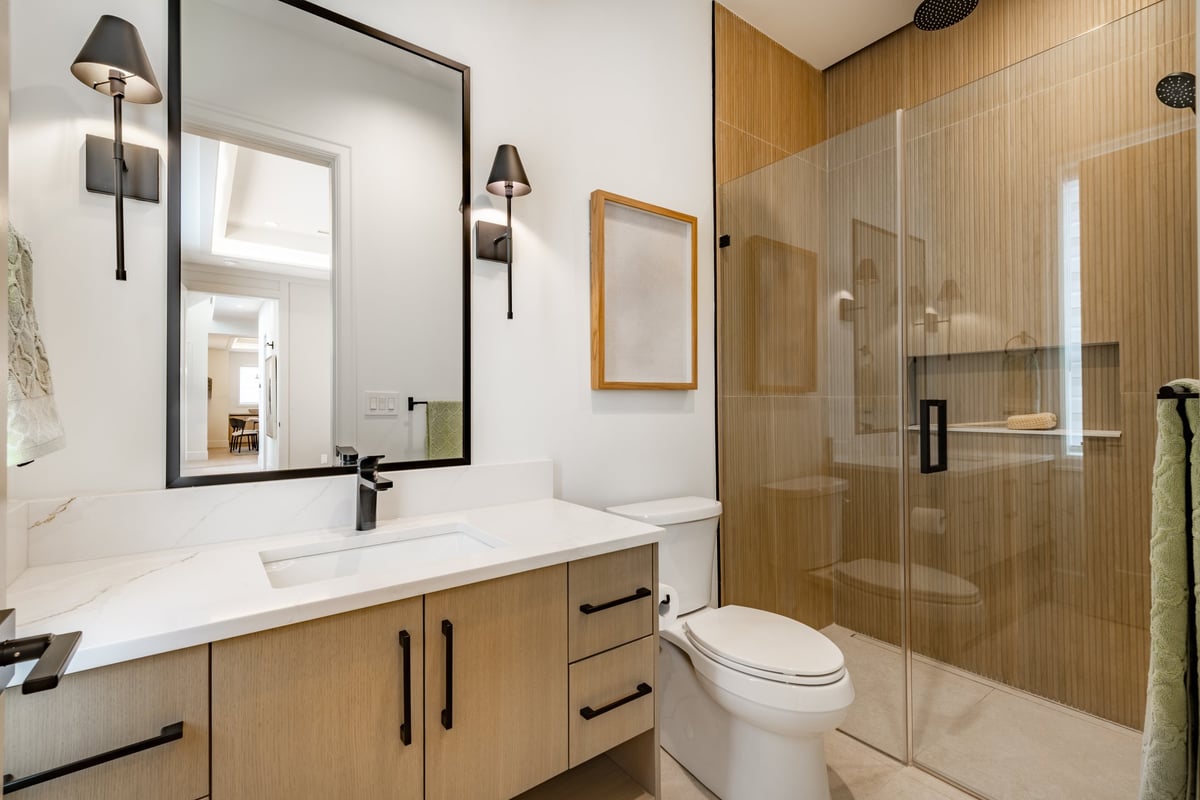
What is typically included: converting a tub/shower combo to a walk-in shower with frameless glass, installing a double vanity with stone or quartz countertop, new tile flooring (often with radiant heat), upgraded lighting with multiple zones, improved ventilation, new fixtures, and new hardware.
The walk-in shower conversion is the centerpiece of most mid-range primary bathroom remodels in DuPage County. The cost for a custom tile walk-in shower with frameless glass enclosure, built-in niches, and a rain showerhead runs $6,000 to $14,000 depending on size, tile selection, and the number of showerhead positions.
Radiant floor heating adds $1,500 to $3,500 to the project depending on bathroom size. In a market where tile or stone flooring is standard and temperatures drop below freezing for four to five months per year, heated floors are one of the most requested features in DuPage County bathroom remodels.
Timeline: 3 to 6 weeks depending on the extent of plumbing changes and custom material lead times.
This is a complete reimagining of the primary bathroom. The layout is reconfigured. Plumbing is relocated. The room is gutted to the studs and rebuilt from the ground up.
What is typically included: removing the existing jetted tub or oversized built-in tub and reconfiguring the floor plan, building an oversized walk-in shower with multiple showerheads and bench seating, installing a freestanding soaking tub in a repositioned location, custom double vanity with natural stone countertop, floor-to-ceiling tile or stone, heated floors, layered lighting, premium fixtures, upgraded plumbing and electrical, and sometimes a dedicated water closet.
This level of renovation is most common in Oak Brook ($55,000 to $75,000+) and Hinsdale ($60,000 to $100,000+), where primary bathrooms are larger, home values are higher, and homeowners select premium materials that match the caliber of a property worth $900,000 to well over $1 million.
Timeline: 5 to 10 weeks depending on complexity, custom material lead times, and permitting schedules.
Considering a bathroom remodel in DuPage County?
Jason Neu gives every LuxeLine client his direct number before they sign anything. See how we work.
Learn About Our ProcessDuPage County is not one market. The community you live in directly affects what your bathroom remodel will cost because it determines the era of your home, the condition of your existing plumbing and electrical, and the material expectations that match your property value.
Hinsdale has the highest bathroom remodel costs in DuPage County. Median home values exceed $1 million. The housing stock includes a significant number of historic and architecturally significant properties. Homeowners here select natural stone (marble, quartzite), custom vanity cabinetry, premium fixtures from brands like Waterworks and Kallista, heated floors, and spa-quality shower systems.
The primary bathroom in a Hinsdale home is often 120 to 200+ square feet, which increases material quantities substantially. A full primary bathroom transformation in Hinsdale commonly runs $60,000 to $100,000 or more. A focused guest bath update runs $25,000 to $38,000.
Oak Brook is DuPage County's executive suburb. Median home values approach $900,000. The housing stock is predominantly single-family detached (84%) with a median build year of 1978. Primary bathrooms in Oak Brook homes from the late 1970s and 1980s typically feature oversized jetted tubs that consume a third of the floor space, narrow shower stalls, and finishes that were considered premium four decades ago.
Removing the jetted tub and reconfiguring the layout for a walk-in shower, freestanding tub, and double vanity is the most common transformation. Mid-range primary renovations run $32,000 to $55,000. Full transformations with premium stone and fixtures reach $55,000 to $75,000+.
Naperville is DuPage County's largest city by population (150,000+) with a median household income above $148,000 and home values between $500,000 and $1 million. The median build year is 1990, which means Naperville bathrooms are not crumbling 1960s tile jobs. They are 1990s builder-grade bathrooms with ceramic tile surrounds, cultured marble vanity tops, single vanity lights, and jetted tubs that were a standard builder upgrade 30 years ago.
The upgrade path is clear: replace the builder ceramic with real tile, swap the cultured marble for quartz, install a walk-in shower, add a double vanity, upgrade the lighting, and add heated floors. Mid-range primary renovations in Naperville run $28,000 to $48,000. Full primary transformations reach $48,000 to $65,000.
Elmhurst has a median home value above $450,000 and a median build year of 1964. Bathrooms in 1960s Elmhurst homes are among the most dated in DuPage County: original ceramic tile, single vanities with no counter space, tub/shower combos, and outdated plumbing that may include galvanized supply lines or original cast iron drains.
The 1960s plumbing factor adds cost that newer homes do not carry. Replacing galvanized supply lines adds $1,500 to $4,000 to the project. Replacing a section of cast iron drain adds $800 to $2,500. These are not optional upgrades. They are conditions that must be addressed when the walls are open, and they are invisible until demolition begins.
Mid-range primary renovations in Elmhurst run $28,000 to $45,000. Full primary transformations reach $45,000 to $60,000.
Villa Park is LuxeLine's headquarters. The median home value is approximately $329,000 and the median build year is 1958, making it one of the oldest housing stocks in DuPage County. Bathrooms here have often been the least-updated room in the home. Many still have original tile, original vanities, and original tub/shower combos from when the house was built.
The same 1950s-era plumbing considerations that apply in Elmhurst apply here: galvanized supply lines and cast iron drains that may need replacement. The difference is scale. Villa Park bathrooms are typically smaller than those in the higher-value suburbs, which keeps material costs lower.
Hall bath updates run $15,000 to $22,000. Mid-range primary renovations run $22,000 to $30,000. Full primary renovations with layout changes and heated floors can reach $30,000 to $35,000.
Lombard borders Villa Park to the east and shares a similar housing profile. Median home values sit around $340,000 with homes built primarily in the 1960s and 1970s. Bathroom remodel costs in Lombard track closely with Villa Park, with the same 1960s-era plumbing considerations and similar material expectations.
Schaumburg is the most accessible market in DuPage County for bathroom remodeling. Median home values sit between $320,000 and $385,000 with a median build year of 1979. The housing stock includes a higher proportion of townhouses and condominiums than other DuPage County communities, which affects both the scope of work and the total cost (smaller bathrooms, potentially simpler plumbing access, possible HOA coordination).
Hall bath updates run $12,000 to $20,000. Mid-range primary renovations run $20,000 to $35,000. Full primary renovations can reach $35,000 to $45,000.
A bathroom remodel in the $20,000 to $30,000 range in a $350,000 Schaumburg home delivers one of the strongest returns on investment in DuPage County.
Understanding where the money goes helps you make informed decisions about where to invest and where to save. Here is what each major component of a DuPage County bathroom remodel typically costs in 2026.
Gutting an existing bathroom down to the studs includes removing tile from floors and walls, pulling out the vanity, disconnecting and removing the tub or shower, removing the toilet, and hauling everything away. Older DuPage County homes with mortar-set tile, plaster walls, or multiple layers of flooring take longer to demo and cost more to dispose of.
Plumbing is the cost component with the widest variance. If the layout stays and connections remain in place, plumbing costs are at the lower end (new supply lines, new drain connections, new fixture installations). If you are relocating the shower, moving from a single to double vanity, or adding a freestanding tub with a floor-mounted filler, the plumbing scope expands significantly.
Specific DuPage County plumbing costs to budget for:
This is the most important line item in a bathroom remodel, and it is the one that most cost guides skip entirely. Waterproofing a shower and wet area with a liquid membrane system and pre-formed shower pan costs $800 to $2,500 depending on the size of the wet area. It is invisible after tile is installed. It is what prevents mold, rot, and structural damage behind the walls.
A bathroom that skips proper waterproofing will develop problems within two to five years. A bathroom built with it will perform for decades. This is not a place to save money.
Tile is typically the second-largest cost component after labor. The range is wide because material selection varies enormously.
Add $1,500 to $3,500 for a custom shower floor (mosaic tile, linear drain, and precise slope work).
This combines tile, glass, fixtures, and waterproofing into one number since these elements are designed and built as a unit.
Electric radiant heat mats installed under tile flooring with a dedicated thermostat. Cost varies by bathroom size. A 50-square-foot bathroom runs approximately $1,500. A 100-square-foot primary bathroom runs $2,500 to $3,500. This includes the heating mats, thermostat, dedicated electrical circuit, and installation labor.
The tub itself ranges from $1,200 for an acrylic freestanding model to $5,000+ for a cast stone or specialty material. Add $1,500 to $4,500 for the freestanding tub filler (wall-mounted or floor-mounted) and plumbing connections including a floor drain.
Replacing a single vanity strip light with layered lighting (recessed ceiling fixtures, vanity sconces or backlit mirror, accent lighting in shower niches) runs $800 to $3,000 including fixtures and wiring.
GFCI outlets at all code-required locations, dedicated circuit for heated floors, wiring for new lighting, and pre-wiring for heated towel bars or smart mirrors. Older DuPage County homes with original electrical panels may need a panel evaluation to support the additional load, which can add $1,500 to $3,000 if an upgrade is required.
Replacing a noisy, undersized builder-grade exhaust fan with a properly sized, quiet unit. The fan itself costs $150 to $500. Installation and venting run $150 to $700 depending on whether existing ductwork can be reused.
Toilet, faucets, showerheads, towel bars, robe hooks, toilet paper holders, and other hardware. A standard Kohler or Delta fixture package runs $500 to $1,200. A premium package (Brizo, Rohl, or similar) runs $1,500 to $3,500.
Walls and ceiling. Moisture-resistant paint formulated for bathrooms. Includes prep, primer, and two coats.
National bathroom remodel cost guides treat every home the same. In DuPage County, the decade your home was built is one of the strongest predictors of what your remodel will actually cost.
These homes were built with galvanized steel water supply lines, cast iron drain pipes, and fuse boxes or early circuit breaker panels. Bathrooms are small by modern standards (40 to 60 square feet). Walls are often plaster over lath rather than drywall.
What this means for cost: the plumbing and electrical infrastructure behind the walls may need replacement or significant upgrading. You are not just installing new tile over old walls. You are often replacing the supply lines, upgrading the drains, adding circuits, and installing drywall over framing that was never designed for modern loads. Budget an additional $3,000 to $7,000 for infrastructure upgrades that a 1990s home would not require.
Copper supply lines replaced galvanized in most homes from this era, but cast iron drains are still common. Electrical panels are typically 100 to 150 amps, which may be adequate but should be evaluated. Bathrooms are slightly larger than 1950s homes but still compact by current standards.
Budget an additional $1,500 to $4,000 for potential cast iron drain replacement and electrical evaluation.
These homes were generally built with copper supply lines and ABS or PVC drain lines. Electrical panels are typically 200 amps. The plumbing and electrical infrastructure is usually in serviceable condition. The primary cost driver is not infrastructure replacement but layout reconfiguration: removing the oversized jetted tub, expanding the shower, and upgrading finishes from 1980s-era ceramic and chrome to current standards.
The newest housing stock in DuPage County's LuxeLine service area. Plumbing is copper or PEX. Drains are ABS or PVC. Panels are 200 amps. The infrastructure is generally fine. The cost is driven almost entirely by the scope of the aesthetic and functional upgrade: replacing builder-grade finishes with custom tile, stone, and fixtures.
Timeline depends on project scope. Here are realistic timeframes for DuPage County bathroom remodels in 2026.
Hall Bath / Guest Bath
2-3 Weeks
No layout changes
Mid-Range Primary
3-6 Weeks
Walk-in shower, double vanity, heated floors
Full Transformation
5-10 Weeks
Layout reconfiguration, custom tile, multiple features
The variables that extend timelines in DuPage County specifically are:
Here is a practical approach to budgeting that accounts for how projects actually work, not how cost calculators imagine them.
Decide what you want the bathroom to accomplish before you set a dollar number. A walk-in shower, double vanity, and heated floors in a primary bathroom is a different scope than a fresh tile job and new vanity in a guest bath. The scope determines the budget range, not the other way around.
Online calculators use square footage and zip code to generate a number. They cannot see your galvanized plumbing, your undersized electrical panel, your cracked shower pan, or the layout constraints of your specific bathroom. An on-site consultation with a licensed contractor who opens cabinets, checks the panel, evaluates the plumbing access, and measures the space will give you a budget range that is grounded in reality.
Bathrooms in older DuPage County homes frequently reveal conditions behind the walls that were not visible during the initial assessment. Water damage under the tub. Deteriorated subfloor under the toilet. Outdated wiring behind the vanity. A contingency buffer prevents these discoveries from derailing the project.
If the budget is tight, spend more on the waterproofing system and the plumbing connections and less on the tile selection. A well-waterproofed shower with $10 porcelain tile will outperform a poorly waterproofed shower with $40 marble. The stuff behind the tile is what makes the bathroom last.
These are the mistakes we see most frequently when homeowners hire contractors who do not specialize in bathroom work or who cut corners on elements that are invisible after installation.
The most expensive mistake. A shower built without a proper waterproofing membrane will leak behind the walls within two to five years. The resulting mold and structural damage cost more to remediate than the original remodel cost to build. LuxeLine uses liquid membrane waterproofing systems and pre-formed shower pans on every project.
Fiberglass absorbs moisture. In a bathroom with steam, humidity, and temperature swings, fiberglass batts in exterior walls promote mold growth. Closed-cell spray foam or rigid foam insulation is the correct choice for bathroom applications.
In DuPage County homes built before 1975, the plumbing behind the walls is 50 to 70 years old. If the contractor does not evaluate the supply lines and drains before quoting the project, the homeowner gets surprised by a $3,000 to $5,000 plumbing add-on after demolition reveals galvanized pipes or corroded cast iron.
The lowest bid is often the contractor who skipped waterproofing in the estimate, did not account for plumbing evaluation, or plans to use fiberglass batts. A bid that is 20% lower than the others is not a deal. It is a list of things that were not included.
Online calculators give you a range. An on-site consultation gives you a budget you can plan around.
Schedule a free consultation with Jason Neu, owner and licensed general contractor. He will visit your DuPage County home, assess your bathroom, evaluate your plumbing and electrical conditions, and give you a written scope of work, a realistic budget range, and a proposed timeline. No pressure. No obligation.
Schedule Your Free ConsultationOr call Jason directly: (773) 389-2066
Owner & Licensed General Contractor
Jason Neu is the owner, founder, and licensed general contractor behind LuxeLine Remodeling, headquartered in Villa Park, IL. He has over 10 years of residential remodeling experience across two states and leads every LuxeLine project personally from consultation through final walkthrough. LuxeLine offers a 24-month workmanship guarantee on every bathroom remodel.
Learn more about Jason and LuxeLineCost & Planning
Detailed pricing for half baths, guest bathrooms, and compact primary bathrooms in the Chicago suburbs.
Timeline
From demolition to final walkthrough: a realistic week-by-week breakdown of a DuPage County bathroom project.
Decision Making
The case for and against jetted tub removal, what buyers want in 2026, and the ROI of tub-to-shower conversions.

Premium home remodeling across the Greater Chicago & Milwaukee Area. Licensed General Contractor.
2026 LuxeLine Remodeling. All rights reserved.
Villa Park, IL | Licensed General Contractor
Premium home remodeling across the Greater Chicago & Milwaukee Area. Licensed General Contractor.

2026 LuxeLine Remodeling. All rights reserved.
Villa Park, IL | Licensed General Contractor