Serving the Greater Chicago & Milwaukee Area
|
Licensed General Contractor

Jason Neu
Owner & Licensed General Contractor
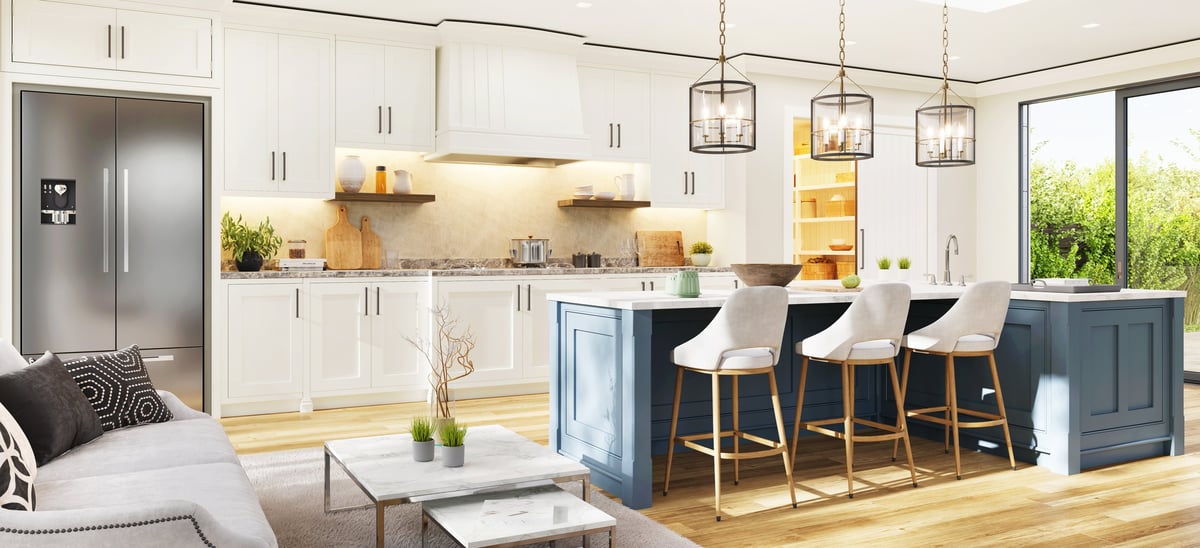
A kitchen remodel in the Chicago suburbs costs between $22,000 and $150,000 or more in 2026, depending on the scope of work, the community you live in, and the materials you select. A cosmetic refresh with new cabinets, countertops, and flooring but no layout changes typically runs $22,000 to $45,000. A mid-range renovation with layout modifications, custom cabinetry, and upgraded appliances falls between $40,000 and $85,000. A full gut renovation with structural changes, professional-grade appliances, and premium finishes in luxury communities like Hinsdale or Oak Brook can reach $85,000 to $150,000 or more.
Those ranges are specific to the western suburbs of Chicago, where LuxeLine Remodeling is headquartered. National cost guides from Angi, HomeAdvisor, and This Old House cite average kitchen remodel costs between $15,000 and $50,000, with "major" remodels at $50,000 to $70,000. Those numbers reflect national medians. They are not accurate for the Chicago suburbs, where construction costs run 15 to 25% above national averages due to higher labor rates, stricter permitting requirements, and the material expectations of homeowners in a market where the median home value exceeds $400,000.
This guide breaks down what a kitchen remodel actually costs in the western suburbs of Chicago in 2026. It is organized by the variables that drive cost: project type, community, individual components, and the age of your home.
Every national cost guide underestimates what Chicago suburban homeowners actually pay. Here is why.
General contractors in DuPage County charge $90 to $115 per hour. Plumbers charge $105 to $135 per hour (national average: $90). Electricians charge $95 to $125 per hour (national average: $85). Cabinet installers charge $105 to $135 per hour. These rates reflect the cost of living in the western suburbs, the licensing requirements in Illinois, and the demand for skilled trades in a market where more homeowners want renovations than there are qualified contractors to build them.
The median household income in DuPage County is approximately $107,000. In Naperville it exceeds $148,000. In Hinsdale and Oak Brook, it is significantly higher still. Homeowners in these markets select materials that match their homes and their communities. Quartz or natural stone countertops, semi-custom or custom cabinetry, porcelain tile backsplashes, and stainless steel or professional-grade appliances are standard selections. National guides that assume laminate countertops and stock cabinetry understate what western suburb homeowners actually spend.
Every municipality in the western suburbs has its own building department, fee schedule, and inspection process. Kitchen remodels involving electrical, plumbing, structural, or HVAC changes require permits. Hinsdale requires architectural review for exterior modifications. Naperville straddles DuPage and Will counties. Schaumburg is in Cook County with its own permitting framework. These are costs and timelines that national calculators do not account for.
Western suburb homes span seven decades of construction. A kitchen remodel in a 1958 Villa Park home involves different plumbing, electrical, and structural conditions than a 1990 Naperville home. Galvanized supply lines, cast iron drains, undersized electrical panels, and original framing that does not meet current code create costs that only become visible once demolition begins. More on this below.
The scope of your kitchen remodel is the single biggest factor in cost. Here is what each level of renovation typically costs in the Chicago suburbs in 2026.
The existing kitchen layout stays. Plumbing connections, gas lines, and electrical circuits remain in their current locations. The work focuses on replacing the surfaces, fixtures, and visible elements.
This is the most common kitchen remodel in the western suburbs. It involves meaningful changes to how the kitchen functions, not just how it looks.
The island is often the centerpiece. Adding a kitchen island where one did not exist before requires extending plumbing (if the island includes a prep sink), adding electrical (outlets and lighting), and sometimes modifying the HVAC ductwork in the floor. An island with a prep sink, dishwasher, and seating adds $8,000 to $15,000 to the project depending on size and material.
A complete reimagining of the kitchen. The room is gutted to the studs and rebuilt. Layout changes are structural: walls come down, soffits are removed, sightlines open up.
Wall removal: $5,000 to $15,000 depending on whether the wall is load-bearing (requiring a steel beam, temporary supports, and structural engineering) or non-load-bearing (requiring framing modification, patching, and floor/ceiling transitions).
Professional-grade appliances add significantly to the total. A Wolf 6-burner range with griddle runs $8,000 to $12,000 for the appliance alone. A Sub-Zero built-in refrigerator runs $9,000 to $15,000. A Thermador dishwasher with custom panel runs $1,500 to $2,500. The appliance package in a luxury kitchen can easily reach $25,000 to $45,000.
Planning a kitchen remodel in the western suburbs? Jason Neu gives every LuxeLine client his direct number before they sign anything. See how we work.
Learn About Our ProcessThe western suburbs of Chicago are not one market. The community you live in directly affects what your kitchen remodel costs because it determines the era of your home, the condition of your existing plumbing and electrical, and the material expectations that match your property value.
Hinsdale has the highest kitchen remodel costs in the western suburbs. Median home values exceed $1 million. The housing stock includes historic properties, architecturally significant homes, and newer construction that all demand premium finishes.
Homeowners here select custom cabinetry (not semi-custom), natural stone countertops (quartzite, marble), professional-grade appliance suites (Wolf, Sub-Zero, Thermador), and custom ventilation systems. The kitchen in a Hinsdale home is often 200 to 400 square feet, which increases material quantities substantially.
Hinsdale also requires architectural review for projects involving exterior modifications (window changes, additions to the kitchen footprint), which adds time to the permitting process.
A mid-range renovation in Hinsdale runs $65,000 to $95,000. A full gut renovation with structural changes and professional-grade appliances commonly reaches $100,000 to $125,000 or more.
Learn more about Hinsdale kitchen remodelsOak Brook is DuPage County's executive suburb. Median home values approach $900,000. The housing stock is predominantly single-family detached (84%) with a median build year of 1978.
Kitchens in Oak Brook homes from the late 1970s and 1980s are often large but dated: dark wood cabinetry, tile countertops or early granite, fluorescent ceiling fixtures, and layouts designed around the work triangle rather than open-concept living.
The most common transformation opens the kitchen to the family room, replaces the cabinetry and countertops, installs a large island, upgrades to professional-grade appliances, and adds layered lighting. Mid-range renovations run $55,000 to $80,000. Full gut renovations with wall removal and appliance upgrades reach $85,000 to $100,000+.
Learn more about Oak Brook kitchen remodelsNaperville is the largest city in the LuxeLine service area (150,000+ residents) with a median household income above $148,000 and home values between $500,000 and $1 million. The median build year is 1990.
Naperville kitchens are not crumbling 1960s galley layouts. They are 1990s builder-grade kitchens: oak cabinets with cathedral-arch doors, laminate or early granite countertops, ceramic tile backsplashes, single vanity lights, and standard-grade appliances. The bones are fine. The finishes need to come into the current decade.
The upgrade path is clear: replace the oak cabinets with painted shaker or flat-panel designs, swap laminate for quartz, install a real tile backsplash, add an island if the layout allows, upgrade to stainless steel appliances, and add recessed and under-cabinet lighting.
Mid-range renovations in Naperville run $45,000 to $65,000. Full renovations with island additions and appliance upgrades reach $65,000 to $85,000.
Naperville's dual-county permitting (DuPage and Will) can affect the process depending on which side of the county line the home sits.
Learn more about Naperville kitchen remodelsElmhurst has a median home value above $450,000 and a median build year of 1964. Kitchens in 1960s Elmhurst homes are among the most dated in the western suburbs: small footprints, closed-off layouts separated from the dining and living rooms by walls, original cabinetry, and outdated plumbing and electrical.
The 1960s infrastructure factor adds cost. Galvanized supply lines (replacement: $2,000 to $5,000). Cast iron drain lines (section replacement: $1,000 to $3,000). Electrical panels at 100 amps or less (upgrade to 200 amps: $2,500 to $4,500). These are not optional upgrades. They are conditions that must be addressed when the walls are open.
Opening the kitchen to the living or dining room is the most impactful structural change in these homes and is requested on the majority of Elmhurst kitchen remodels. If the wall is load-bearing (which it often is), the steel beam and structural work adds $5,000 to $12,000.
Mid-range renovations in Elmhurst run $40,000 to $55,000. Full renovations with wall removal and infrastructure upgrades reach $55,000 to $75,000.
Learn more about Elmhurst kitchen remodelsVilla Park is LuxeLine's headquarters. Median home value is approximately $329,000 with a median build year of 1958, making it one of the oldest housing stocks in the western suburbs. Kitchens here are small by current standards and share the same infrastructure challenges as Elmhurst: galvanized plumbing, cast iron drains, and undersized electrical panels.
The difference is scale. Villa Park kitchens are typically 80 to 120 square feet, which keeps material costs lower than in larger suburban kitchens. A mid-range renovation that would cost $55,000 in Elmhurst or $65,000 in Naperville can often be achieved for $35,000 to $45,000 in Villa Park because the room is simply smaller.
A $30,000 to $40,000 kitchen remodel in a $329,000 Villa Park home delivers one of the strongest returns on investment in the western suburbs.
Learn more about Villa Park kitchen remodelsLombard borders Villa Park to the east and shares a similar housing profile. Median home values sit around $340,000 with homes built primarily in the 1960s and 1970s. Kitchen remodel costs in Lombard track closely with Villa Park.
Learn more about Lombard kitchen remodelsSchaumburg is the most accessible market in the western suburbs for kitchen remodeling. Median home values sit between $320,000 and $385,000 with a median build year of 1979. The housing stock includes a higher proportion of townhouses and condominiums, which affects scope (smaller kitchens, potentially simpler plumbing access, possible HOA coordination for condos).
Cosmetic refreshes run $22,000 to $32,000. Mid-range renovations run $32,000 to $45,000. Full renovations can reach $45,000 to $55,000.
A kitchen remodel in the $30,000 to $40,000 range in a $350,000 Schaumburg home is one of the most cost-effective renovations in the western suburbs.
Learn more about Schaumburg kitchen remodelsUnderstanding where the money goes helps you make informed decisions about where to invest and where to save.
Cabinetry is the single largest cost component in most kitchen remodels, typically consuming 30 to 40% of the total budget. A typical western suburb kitchen has 20 to 30 linear feet of cabinetry.
$150–$300/linear ft
Total: $3,000–$9,000. Pre-manufactured standard sizes. Fastest delivery (1–3 weeks).
$300–$600/linear ft
Total: $6,000–$18,000. Made to order with more finish options. Lead time: 4–6 weeks.
$500–$1,200/linear ft
Total: $10,000–$36,000. Built to exact specifications. Lead time: 8–12 weeks.
Quartz
Engineered stone, low maintenance
Granite
Natural stone, heat resistant
Quartzite
Harder than granite, marble-like
Marble
Porous, beautiful, needs care
A typical western suburb kitchen with 40 to 60 square feet of countertop surface runs $3,500 to $9,000 for quartz and $5,000 to $15,000 for premium natural stone.
Typical kitchen: 100–200 sq ft. Some projects extend to adjacent rooms.
$3,000–$8,000
Name-brand stainless steel: range, refrigerator, dishwasher, microwave
$8,000–$15,000
Better brands, larger capacity, more features
$25,000–$45,000
Wolf, Sub-Zero, Thermador. Wolf 6-burner: $8K–$12K. Sub-Zero fridge: $9K–$15K.
100-amp panel upgrade: $2,500–$4,500
Only for wall removal projects.
Walls, ceiling, trim. Includes prep, primer, and two coats.
The decade your home was built is one of the strongest predictors of what your kitchen remodel will cost in the western suburbs. National guides treat every home the same. Here is what actually changes by era.
Villa Park, parts of Elmhurst
Budget an additional $5,000 to $10,000 for infrastructure upgrades.
Elmhurst, Lombard, parts of Schaumburg
Budget an additional $3,000 to $7,000 for potential upgrades.
Oak Brook, parts of Schaumburg
The cost driver is scope, not infrastructure: removing soffits, opening sightlines, replacing dated surfaces.
Naperville
Cost is driven almost entirely by replacing builder-grade finishes: oak cabinets → painted shaker. Laminate → quartz.
Decide whether you need a cosmetic refresh, a mid-range renovation with layout changes, or a full gut renovation. The scope determines the budget range, not the other way around.
Online calculators use square footage and zip code. They cannot see your galvanized plumbing, your undersized panel, your load-bearing wall, or the layout constraints of your specific kitchen. An on-site consultation with a licensed contractor gives you a budget range grounded in reality.
Kitchens in older western suburb homes frequently reveal conditions behind the walls and under the floors that were not visible during the initial assessment. Deteriorated subfloor. Water damage behind the dishwasher. Undersized gas lines. A contingency buffer prevents these discoveries from derailing the project.
A $4,000 range in a well-designed kitchen will outperform a $12,000 range in a poorly laid-out kitchen. Cabinetry defines the look, the storage, and the daily usability of the kitchen for 15 to 20 years. Appliances get replaced every 8 to 12 years. Invest accordingly.
In a market where qualified kitchen remodelers are in high demand, a bid that is 20 to 30% below the others is not a deal. It is a list of things that were not included: permitting, proper electrical, structural engineering for load-bearing walls, or the infrastructure upgrades that your home needs.
The door is 10% of what matters about a cabinet. The box construction, the drawer glides, the hinge quality, the interior organization, and the finish durability are what determine whether the cabinets hold up for 5 years or 20. A beautiful door on a particleboard box with cheap hinges is a $15,000 mistake you will feel every time you open a drawer.
In homes built before 1980, the existing panel may not have capacity for the circuits a modern kitchen requires. A panel upgrade during construction adds $2,500 to $4,500. Discovering this need after the budget is set creates a painful choice between cutting scope elsewhere or going over budget.
Professional-grade appliances (Wolf, Sub-Zero, Thermador) can have 4 to 8 week lead times. Standard appliances can take 2 to 4 weeks. Appliances should be on site before cabinet installation so dimensions can be verified against the actual units, not just spec sheets. A range that is a half-inch wider than the spec creates a cabinet modification that costs time and money.
An island is the most requested feature in western suburb kitchen remodels. But an island requires space: 42 inches of clearance on all sides minimum, 48 inches preferred. A kitchen that is too small for an island with proper clearance will feel cramped regardless of how beautiful the island is. Jason evaluates island feasibility during every consultation.
Online calculators give you a range. An on-site consultation gives you a budget you can plan around.
Schedule a free consultation with Jason Neu, owner and licensed general contractor. He will visit your western suburb home, assess your kitchen, evaluate your plumbing, electrical, and structural conditions, and give you a written scope of work, a realistic budget range, and a proposed timeline. No pressure. No obligation.

Owner & Licensed General Contractor
Jason Neu is the owner, founder, and licensed general contractor behind LuxeLine Remodeling, headquartered in Villa Park, IL. He has over 10 years of residential remodeling experience across two states and leads every LuxeLine project personally from consultation through final walkthrough. LuxeLine offers a 24-month workmanship guarantee on every kitchen remodel.
Learn more about Jason and LuxeLine
Premium home remodeling across the Greater Chicago & Milwaukee Area. Licensed General Contractor.

2026 LuxeLine Remodeling. All rights reserved.
Villa Park, IL | Licensed General Contractor